
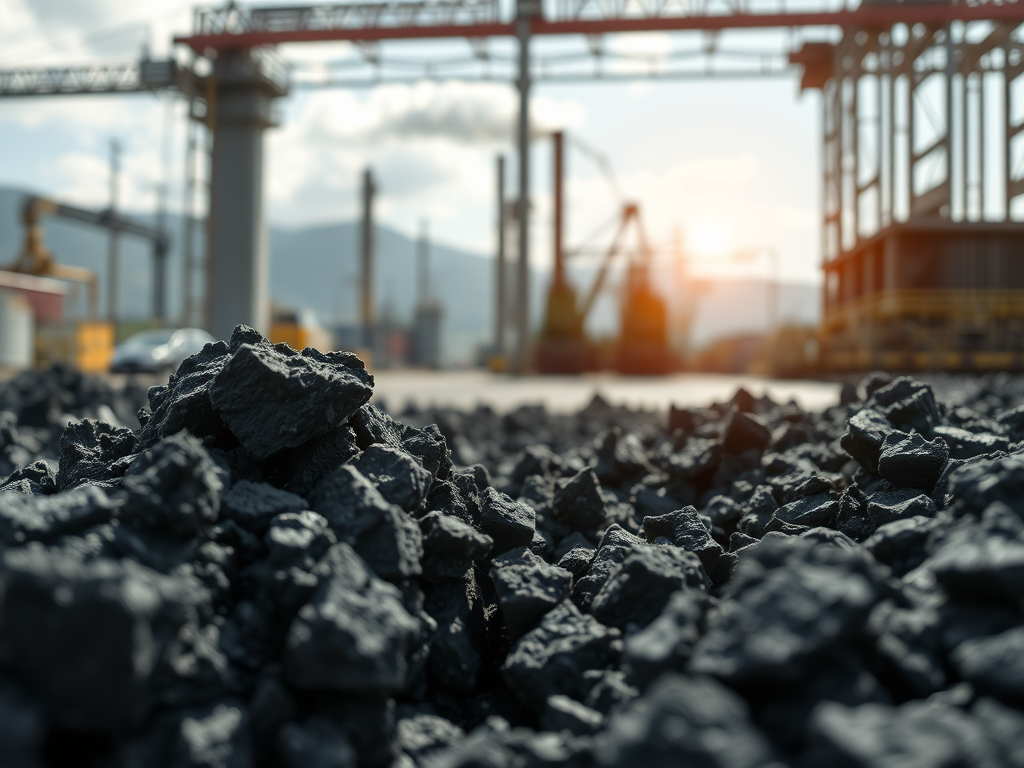
The United States has imposed a 93.5% anti-dumping tariff on battery-grade graphite imports from China, raising total effective duties to 160%. The move is aimed at countering what U.S. producers describe as unfairly low Chinese export prices that have stalled the growth of a domestic graphite industry. The tariff decision follows a petition by the American Active Anode Material Producers, a coalition including Novonix Anode Materials, Syrah Technologies, Anovion Technologies, Epsilon Advanced Materials, and SKI US Inc.
Despite over $10 billion in announced graphite production projects across the U.S., most have not progressed beyond planning. Producing battery-grade graphite domestically still costs more than twice as much as importing it from China. High capital costs, lack of secondary markets for byproducts, and lengthy product qualification timelines all contribute to the gap. Even with new federal subsidies and tax credits for batteries and EVs, investors remain cautious.
These challenges were the focus of two major roundtables hosted by Stanford’s STEER initiative. The events brought together more than 150 experts from industry, government, and academia to evaluate the economic and technical barriers facing U.S. graphite production. Participants discussed commercial strategies such as low-interest loans, long-term offtake agreements with price floors, and expanded battery recycling as ways to stabilize the market and lower risk for investors.
Several technical options were also reviewed. Methane pyrolysis, which converts natural gas into hydrogen and graphite, was highlighted as a potential low-cost production route. Producing graphite from biomass using iron catalysts could further reduce dependence on fossil sources, though purity remains a challenge. Recycling spent batteries to recover graphite is seen as the most scalable short-term solution.
Most of these technologies are still five or more years away from commercial deployment. In the meantime, demand for battery-grade graphite has quadrupled in the last five years, and there is no viable substitute. As long as China maintains pricing power and global supply dominance, the U.S. remains strategically exposed.
The new tariffs signal a shift toward more aggressive trade policy but will need to be matched by clear domestic strategy. Without public investment, offtake commitments, and a focused innovation push, the U.S. risks falling short in its goal to build a secure and competitive graphite supply chain.
Unlike the U.S., the EU has not imposed anti-dumping tariffs on battery-grade graphite from China. Existing EU duties, ranging from 25.5% to 74.9%, apply only to graphite electrode systems used in steelmaking. These do not include the powder or flake graphite used in lithium-ion batteries. So far, the EU has focused on domestic project support rather than trade measures to protect its battery-grade graphite supply.
Leave a Reply